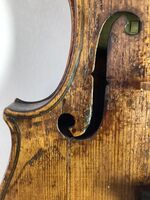
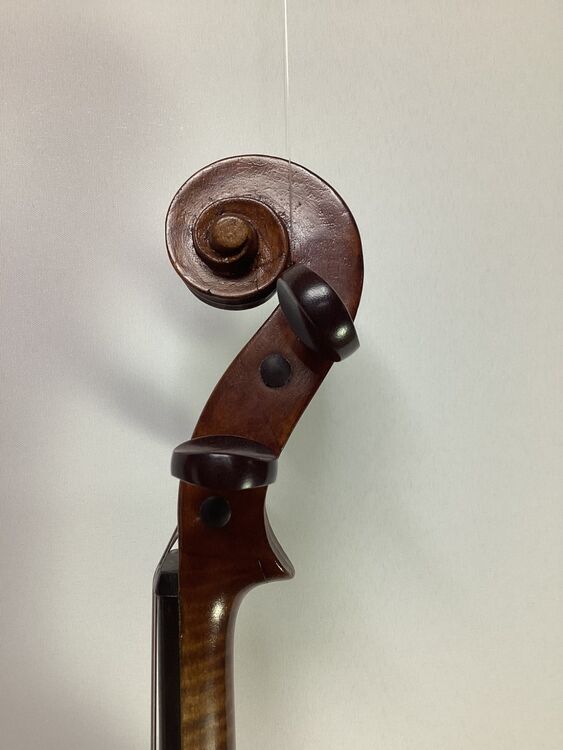
R Early English Violin, Circa 173? £3,500
This violin was acquired by me late 2025 at a UK auction, and was in a seriously dilapidated condition, having presumably resided on a restorer’s shelf for many years waiting for it’s chance to live again.
Bearing no makers name, there are 3 decipherable inscriptions on the inside, the first, where a maker’s label should be it reads “Repaired 1757”, again on the inside of the back in the upper bouts it reads: Repaired 1903, Frank H. Howard, Violinmaker, Nottingham”, and finally on the inside upper belly a further inscription “Rep’d by H. Kirk, Sept 15th, 1886”
So clearly it has had a life and passed through many hands, with a similar pencil inscription from me before I closed the box.
Starting life a Baroque instrument, most of the damage seemed to be in the region of the neck root, shoulder, top block and button, where clearly multiple attempts over the years to restore it to a stable joint have resulted in a basket case held together with screws from the outside and nails from within, none of which were viable repairs any longer. Closer examination of the varnish finish suggests to me that the neck and scroll are not original to the rest of the body, although they are well matched and go well together.
Both are made on the Jacob Stainer model, popular amongst English makers at this time, and the repairers date of 1757 suggests an earlier date of manufacture, possibly 10-20 years earlier, which would make it contemporary with the London makers of the time, so a likely originator could be amongst John Johnson, Daniel Wright, David Furber or Cahusac, all of whom were active in the Cheapside of London during the early part of the 18th Cent. My own research has proved fruitless, but if anyone can determine the maker from the attached photographs, I would be very interested to hear from you.
This violin has undergone a sensitive restoration by me, ensuring to preserve as much of the original material (as found by me) as possible, earlier work carried out includes re-barring, studding, crack and work treatment on the belly and some ribs and missing wood replaced on the first turn of the scroll (both sides)
My work includes: Replacement of the lower block, replacing upper and lower linings in some places, grafting new wood onto the neck heel and shoulder, grafting new wood into the lower ribs at centre join, upper treble belly corner, new wood inserted into button , soundpost patch, peg holes rebushed with spiral bushing. Thorough cleaning of body and sensitive restoration of the finish, retaining as much of the original (as found by me) varnish as possible.
Finally fitted up with new fittings and strung up, the tone is very sweet and quite loud, unusual for a Stainer-style instrument with a high arching, but this violin has a punchy and penetrating voice, that will delight anyone who plays it
Bearing no makers name, there are 3 decipherable inscriptions on the inside, the first, where a maker’s label should be it reads “Repaired 1757”, again on the inside of the back in the upper bouts it reads: Repaired 1903, Frank H. Howard, Violinmaker, Nottingham”, and finally on the inside upper belly a further inscription “Rep’d by H. Kirk, Sept 15th, 1886”
So clearly it has had a life and passed through many hands, with a similar pencil inscription from me before I closed the box.
Starting life a Baroque instrument, most of the damage seemed to be in the region of the neck root, shoulder, top block and button, where clearly multiple attempts over the years to restore it to a stable joint have resulted in a basket case held together with screws from the outside and nails from within, none of which were viable repairs any longer. Closer examination of the varnish finish suggests to me that the neck and scroll are not original to the rest of the body, although they are well matched and go well together.
Both are made on the Jacob Stainer model, popular amongst English makers at this time, and the repairers date of 1757 suggests an earlier date of manufacture, possibly 10-20 years earlier, which would make it contemporary with the London makers of the time, so a likely originator could be amongst John Johnson, Daniel Wright, David Furber or Cahusac, all of whom were active in the Cheapside of London during the early part of the 18th Cent. My own research has proved fruitless, but if anyone can determine the maker from the attached photographs, I would be very interested to hear from you.
This violin has undergone a sensitive restoration by me, ensuring to preserve as much of the original material (as found by me) as possible, earlier work carried out includes re-barring, studding, crack and work treatment on the belly and some ribs and missing wood replaced on the first turn of the scroll (both sides)
My work includes: Replacement of the lower block, replacing upper and lower linings in some places, grafting new wood onto the neck heel and shoulder, grafting new wood into the lower ribs at centre join, upper treble belly corner, new wood inserted into button , soundpost patch, peg holes rebushed with spiral bushing. Thorough cleaning of body and sensitive restoration of the finish, retaining as much of the original (as found by me) varnish as possible.
Finally fitted up with new fittings and strung up, the tone is very sweet and quite loud, unusual for a Stainer-style instrument with a high arching, but this violin has a punchy and penetrating voice, that will delight anyone who plays it
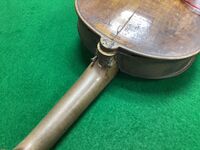
1 Before restoration
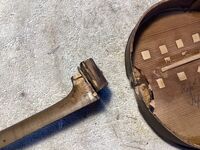
2 Before restoration
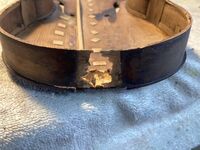
3 Before restoration
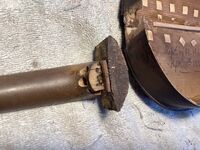
4 Before restoration
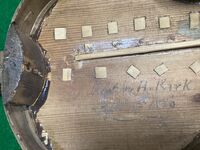
5 Before restoration
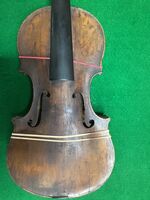
6 Before restoration
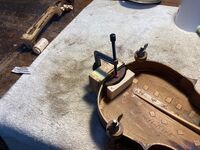
7 During restoration
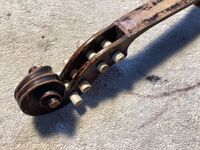
8 During restoration
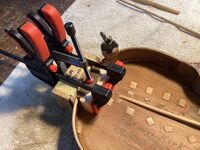
9 During restoration
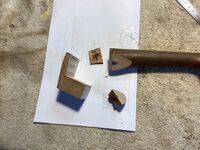
10 During restoration
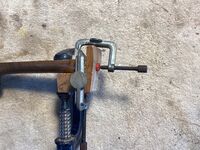
11 During restoration
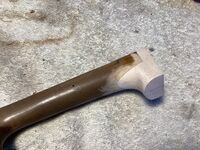
12 During restoration
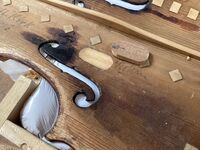
13 During restoration
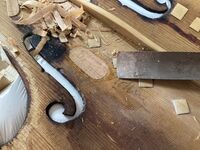
14 During restoration
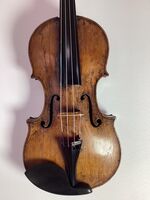
Completed 1
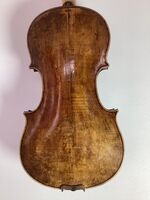
Completed 2
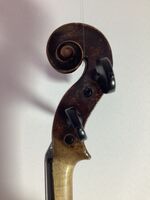
Completed 3
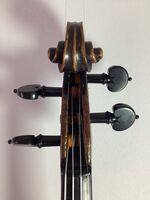
Completed 4
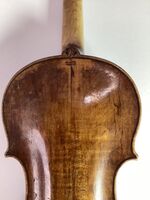
Completed 5
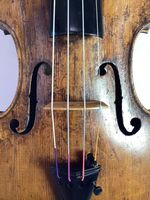
Completed 6